Melbourne Train Network Guide: Lines, Stations & How-To
- Words
- Melbourne Tourism Guide
- Updated
- July 25, 2026
- Read
- 11 min

How to use Melbourne's trains as a tourist — the City Loop, key stations, useful lines, tapping on and off with Myki, V/Line day trips and the Night Network.
This article contains advertising. Our booking links are routed through a partner that adds commission tracking automatically, so if you book through one we earn a commission from the provider, at no extra cost to you. It never affects what we recommend. Affiliate disclosure
If the trams are Melbourne’s charming surface network, the trains are its fast, far-reaching backbone — the way to cover real distance, reach the bayside beaches, get to the sports precinct, or zip out to the suburbs and beyond. For a visitor, the train network looks more complicated than it is: once you understand the City Loop, the two big hub stations and how Myki works, it’s quick and easy. This guide explains the Melbourne train network for tourists — the lines, the stations, how to tap on and off, and the trips worth taking. It’s a key part of our Melbourne public transport guide.
The network at a glance
Melbourne’s metropolitan train network is run by Metro Trains and radiates out from the city centre on around sixteen lines, reaching deep into the suburbs in every direction. In the centre, the lines converge on the City Loop — an underground loop serving five city stations — and the two great hub stations, Flinders Street and Southern Cross. For visitors, the trains are most useful for longer trips and specific destinations (the bay, the sports precinct, the airport region, day-trip towns) rather than short hops around the CBD, where trams and walking usually win. Layered on top is the V/Line regional network, which runs to country Victoria.
How trains work for tourists
The key difference from trams: on trains you must tap on AND tap off with your Myki, touching the readers at the station gates or platforms both when you start and finish your journey. Forget to tap off and you’ll be charged the maximum fare, so make it a habit. You’ll need a Myki (or Mobile Myki) for all train travel — there’s no free zone on trains. As with trams, the daily fare is capped, so once you hit the cap you travel free for the rest of the day. Most visitor destinations sit within the city’s main fare zone. Our Myki guide covers buying and topping up.
The City Loop and city stations
The City Loop is the clever bit. Five stations serve the CBD — Flinders Street, Southern Cross, Melbourne Central, Parliament and Flagstaff — connected by an underground loop, so wherever you are in the city centre, a station is usually a short walk away. Trains loop around the city before heading out to the suburbs (the direction can vary by time of day, which occasionally confuses newcomers, so check the destination displays). For getting across the CBD, though, the trams and your feet are usually quicker than navigating the loop.
The key stations
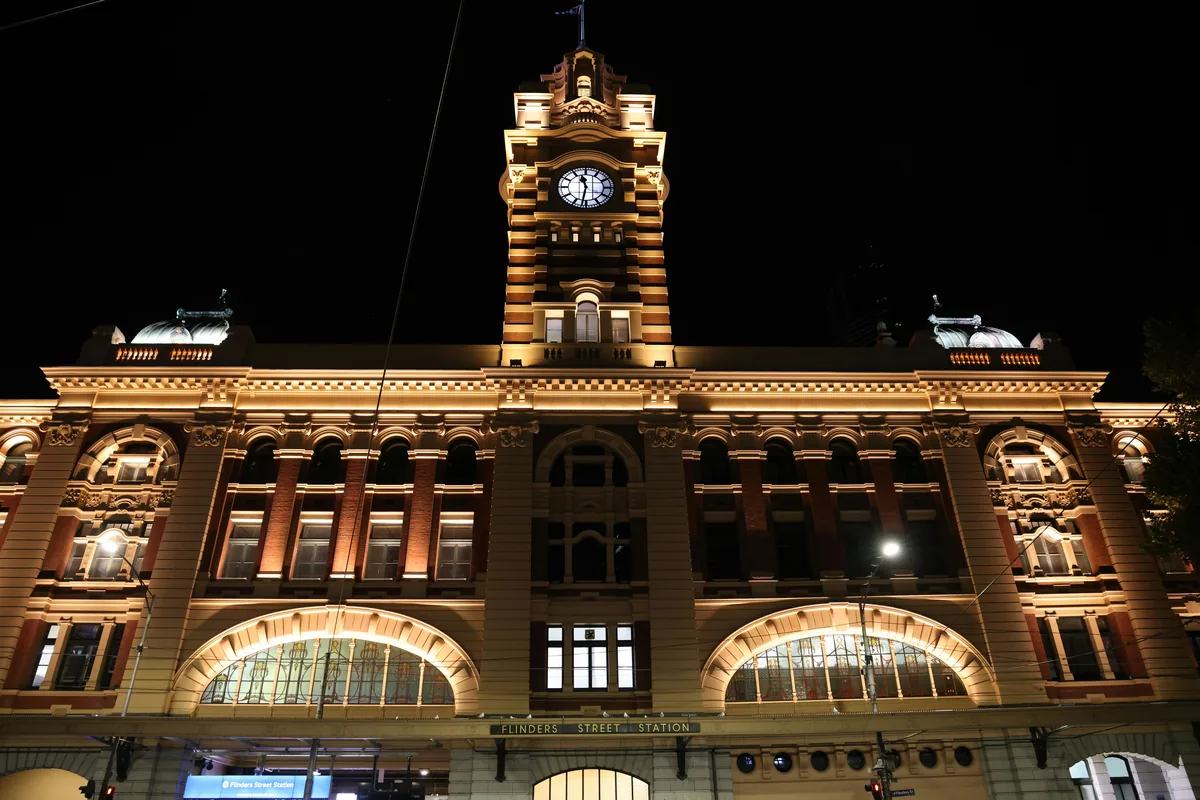
Flinders Street Station is the heart of the network and a city icon — its grand yellow facade and clocks are a Melbourne landmark and a classic meeting point (“under the clocks”). Southern Cross Station, with its distinctive wavy roof, is the hub for V/Line regional trains, interstate trains and the airport SkyBus. Melbourne Central sits beneath a shopping centre, Parliament serves the east end of the city and the theatres, and Flagstaff the west end and gardens. Knowing these five makes navigating the city by train simple.
Useful lines for visitors
Several lines are genuinely handy for sightseeing. The Sandringham line runs down to the bayside suburbs, including Brighton (for the famous bathing boxes) and the beaches. The Belgrave and Lilydale lines head towards the Dandenong Ranges and the Yarra Valley region. The Williamstown line serves Spotswood for Scienceworks and charming Williamstown. The Mernda and Hurstbridge lines run through the inner north. And Richmond and Jolimont stations serve the MCG and sports precinct on game days. For reaching most inner attractions, though, you’ll lean more on trams.
V/Line regional trains
For day trips beyond the city, the V/Line regional network is your friend, departing mainly from Southern Cross Station. Fast, comfortable trains run to Ballarat (for Sovereign Hill), Bendigo (a brilliant car-free day trip), Geelong (gateway to the Great Ocean Road) and other regional centres, typically in one to two hours. V/Line uses Myki for nearer destinations and separate tickets for longer-distance services, so check before you travel. It’s a great, low-stress way to explore regional Victoria without a car — see our day trips guide.
Night Network and frequency
Trains run frequently through the day (every few minutes on the busiest lines in peak, less often off-peak and in the evening). On weekends, the Night Network runs trains all night on most lines, so you can get home in the early hours after a night out — a genuine boon for visitors. Always check the timetable or the PTV app for your specific line, especially late at night or for regional services, as frequencies and last-train times vary. Real-time information is available on the PTV app and Google Maps.
How to catch a train
It’s simple once you’ve done it once. Find your station, tap on at the Myki gates or readers, check the platform and the next-train displays for your line and destination, and board. Tap off at your destination as you exit. City Loop platforms show the stopping pattern, so check that your train stops where you want — most do, but some express services skip stations. Listen for announcements and watch the displays. The PTV app or Google Maps will tell you the platform, the line and the live departure time, taking the guesswork out of it.
Accessibility
Many Melbourne stations are accessible, with lifts, ramps and level access, though some older suburban stations have limitations, so check the PTV accessibility information for your route. Modern trains have designated spaces for wheelchairs and prams, and staff at major stations can assist. The big city stations (Flinders Street, Southern Cross, Melbourne Central) are well equipped. Prams are welcome on trains, and there’s space in most carriages.
Tips for using the trains
Always tap on AND off — unlike trams — or you’ll be overcharged. Use the PTV app or Google Maps for platforms and live times. Check the stopping pattern so you don’t catch an express that skips your stop. Mind the City Loop direction, which changes during the day. Lean on V/Line for car-free day trips. And remember the daily fare cap means a big day of train travel won’t break the bank. For the full system and the apps you’ll want, see our transport guide and useful apps guide.
Flinders Street and a bit of history
Flinders Street Station deserves special mention. Opened in its current form in 1910, its grand Edwardian facade, copper dome and row of clocks make it one of Melbourne’s most photographed buildings and its most famous meeting place — “meet me under the clocks” has been local shorthand for generations. It was once the busiest passenger station in the world, and it remains the symbolic heart of the network, sitting opposite Federation Square at the foot of the city. Even if you’re not catching a train, it’s worth a look. The network as a whole dates back to the 1850s gold-rush boom, and that long history shows in the grand old suburban stations dotted across the city.
Train, tram or walk: when to use each
Melbourne gives you three great ways to get around, and knowing when to use each saves time. Walk within the CBD — it’s compact, flat and walkable, and often faster than waiting for transport. Trams are best for the inner suburbs and the bay-side run to St Kilda, plus free travel within the city centre. Trains win for longer distances: the bayside beaches, the outer suburbs, the sports precinct on game day, and (via V/Line) regional day trips. A typical visitor day might combine all three — walk the CBD, tram to Fitzroy, train to Brighton — with a single capped Myki fare covering the lot. Our tram guide covers the surface network.
Trains to the beach and day trips
Two train trips stand out for visitors. The Sandringham line is your route to the bay — alight at Brighton Beach for the famous painted bathing boxes, or continue to the calm beaches further down the line, all an easy ride from the city. And the V/Line regional services from Southern Cross open up car-free day trips: Bendigo and Ballarat for gold-rush history, Geelong as a gateway to the coast. These turn the train from mere transport into a way to access some of Victoria’s best experiences without hiring a car — a real advantage for visitors who’d rather not drive on the left.
Buying and topping up Myki at stations
You’ll need a Myki before you can travel by train. Buy a card from machines at major stations, from staffed booths, or from convenience stores like 7-Eleven, then load it with value (top up at station machines, online, or via the app). At the bigger stations, gates won’t open without a valid tapped Myki, so make sure yours has enough balance before you reach the platform. Android users can set up Mobile Myki and tap their phone; iPhone options are expanding. Keep your card topped up to avoid being caught short at the gates — our Myki guide has the full how-to.
Safety on the network
Melbourne’s trains are safe and well used, including at night, but a few sensible habits apply. Late at night, travel in the carriages near other passengers or the driver’s end, stay aware on quiet platforms, and use the Night Network with the same street smarts you’d use anywhere. Stations are monitored and most have help points and staff at busier times. Mind the gap between train and platform, stand behind the yellow line, and keep an eye on belongings in crowds. For the wider picture on staying safe in the city, see our Melbourne safety guide.
Common visitor mistakes
A few easy slip-ups catch tourists out. Forgetting to tap off — the single most common and costly error, leading to maximum-fare charges. Catching an express that skips your station — check the stopping pattern on the platform display. Getting confused by the City Loop direction, which reverses through the day — always go by the destination shown, not the platform you expect. Letting the Myki run flat and getting stuck at the gates. And assuming trains are best for short city hops when trams and walking usually win. Avoid these and the network is genuinely easy.
A note on the airport
One thing to know: Melbourne Airport (Tullamarine) does not yet have a direct train line — a rail link is planned but not yet open. For now, the best public-transport option from the airport is the SkyBus, a frequent express coach that runs to Southern Cross Station in the city, from where you can connect to the train and tram network. So your first and last train journeys will likely start or end at Southern Cross after a SkyBus transfer. Our dedicated guide to Melbourne Airport to the city compares all the transfer options in detail.
Frequencies and timetables
Train frequency varies by line and time of day. In peak hours, trains on the busiest lines run every few minutes; off-peak and in the evening, expect waits of 10–20 minutes or more, and regional V/Line services run to set timetables you’ll want to check in advance. The PTV app and Google Maps give live departures and plan your whole journey door to door, including the walk to the station and any tram or bus connections. For evening or regional travel especially, it pays to check the last service times so you’re not caught out — a quick look at the app before you set off saves any surprises.
Frequently asked questions
Do you tap on and off trains in Melbourne?
Yes — on trains you must tap on with your Myki when you start and tap off when you finish, at the station gates or readers. Forgetting to tap off results in being charged the maximum fare. (Trams only require tapping on, outside the Free Tram Zone.)
What is the City Loop?
The City Loop is an underground rail loop serving five CBD stations — Flinders Street, Southern Cross, Melbourne Central, Parliament and Flagstaff — that connects the train lines around the city centre before they head out to the suburbs.
How do I get to regional Victoria by train?
V/Line regional trains depart mainly from Southern Cross Station to Ballarat, Bendigo, Geelong and beyond, usually in one to two hours — a great car-free option for day trips. Nearer destinations use Myki; longer trips need separate tickets.
Are Melbourne trains good for getting around the city?
Trains are best for longer trips — the bay, the suburbs, day-trip towns and the sports precinct. For short hops around the CBD, trams and walking are usually quicker, helped by the central Free Tram Zone.
The bottom line
Melbourne’s trains are the fast, far-reaching half of the city’s transport — perfect for the beaches, the suburbs and car-free day trips, and easy once you’ve mastered the tap-on-tap-off habit and the City Loop. Pair them with the trams for short hops, lean on V/Line to escape the city, and use the PTV app to keep it all simple. Between trains and trams, you can reach almost anywhere a visitor wants to go without ever needing a car.