Melbourne Landmarks: The City’s Icons, Explained
- Words
- Melbourne Tourism Guide
- Updated
- October 3, 2026
- Read
- 23 min
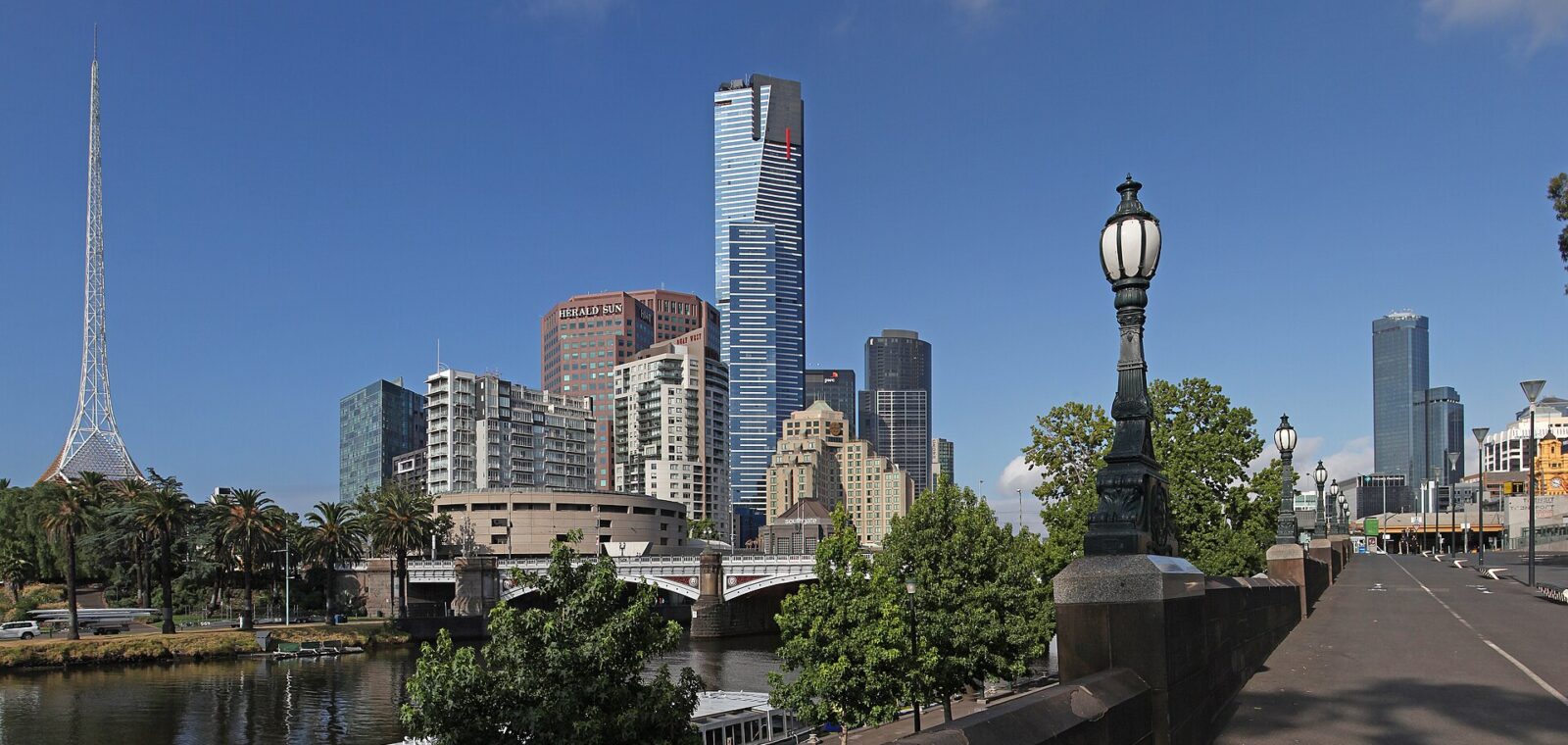
From the clocks at Flinders Street to the dome of the Royal Exhibition Building — the icons that make Melbourne, and how to see them properly.
This article contains advertising. Our booking links are routed through a partner that adds commission tracking automatically, so if you book through one we earn a commission from the provider, at no extra cost to you. It never affects what we recommend. Affiliate disclosure
Stand under the clocks at Flinders Street Station at five to six on a weekday and you’ll see half of Melbourne arranging to meet the other half. It’s a building everyone uses and almost nobody stops to look at, which is true of a surprising number of melbourne landmarks. The city doesn’t have one Opera House or one Harbour Bridge. It has a Victorian-era grid full of gold-rush grandeur, a river lined with modern towers, a sports stadium treated like a cathedral, and a handful of places that mean far more to locals than their postcards suggest.
This guide works through the landmarks district by district: what each one is, why it matters, how long to give it, what it costs, and whether it’s genuinely worth your time. Prices and opening hours were checked in September 2026; treat them as the right order of magnitude and confirm anything ticketed before you go. For the wider picture of what to do in the city, start with our things to do in Melbourne guide.
Melbourne’s Landmarks at a Glance
| Landmark | Area | Cost | Time needed | Verdict |
|---|---|---|---|---|
| Flinders Street Station | CBD | Free to see | 10 min | Essential, and you’ll pass it anyway |
| Federation Square | CBD | Free | 30 min+ | Worth it for what’s inside, not the plaza |
| St Paul’s Cathedral | CBD | Free (donation) | 20 min | Underrated interior |
| State Library Victoria | CBD | Free | 45 min | Unmissable |
| Block Arcade & Royal Arcade | CBD | Free | 30 min | Yes, on a weekday morning |
| Old Melbourne Gaol | CBD | A$38 adult | 1.5–2 h | Good for history buffs and teenagers |
| Melbourne Skydeck (Eureka Tower) | Southbank | Paid | 60–90 min | Best at dusk; skip on a cloudy day |
| Shrine of Remembrance | Kings Domain | Free | 1 h | Essential, and a great free view |
| Royal Exhibition Building | Carlton | Free outside; tour A$29 | 30 min–1 h | The dome tour is worth it |
| Melbourne Cricket Ground | East Melbourne | Tour from ~A$27 | 1.5 h | Yes, even if you don’t like sport |
| Luna Park & St Kilda Pier | St Kilda | Free to see; rides paid | 1–2 h | Go for sunset on the pier |
| Brighton Bathing Boxes | Brighton | Free | 45 min | Pretty, but combine with a beach day |
How Melbourne’s Landmarks Are Laid Out
One of the best things about sightseeing in Melbourne is how compact the core is. Most of the big landmarks fall into five clusters, and the first three are walkable from one another in a morning:
- The Flinders Street corner — Flinders Street Station, Federation Square, St Paul’s Cathedral and Hosier Lane all sit within 200 metres.
- The CBD grid — the arcades, the State Library, the Old Melbourne Gaol, Parliament House and St Patrick’s Cathedral, mostly inside the free tram zone.
- Southbank and St Kilda Road — Eureka Tower, the Arts Centre spire, the NGV and, a pleasant 20-minute walk south, the Shrine of Remembrance and Botanic Gardens.
- Carlton and East Melbourne — the Royal Exhibition Building to the north, the MCG and Fitzroy Gardens to the east.
- The bayside — Luna Park, St Kilda Pier and the Brighton Bathing Boxes, a tram or train ride south.
Everything inside the CBD grid is reachable for free on the trams. Our Melbourne Free Tram Zone guide shows exactly where the free travel ends, which matters because the Shrine, the MCG and the Royal Exhibition Building all sit just outside it.
Flinders Street and Federation Square
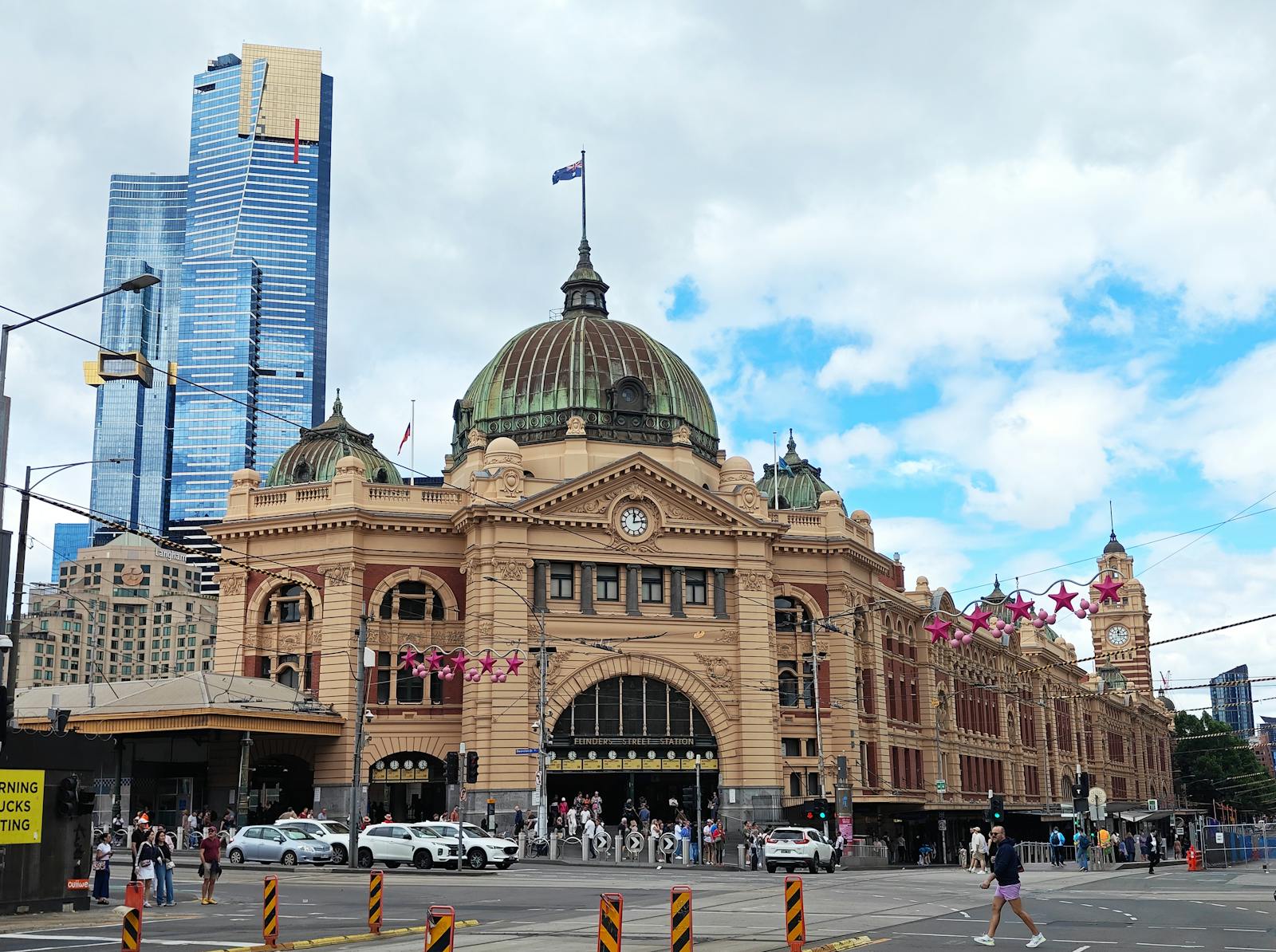
Flinders Street Station
If Melbourne has a single face, this is it. The mustard-and-cream station building on the corner of Flinders and Swanston Streets opened in its current form in 1910, with its green copper dome, arched entrances and the row of clocks above the main steps showing the departure times of each line. “Meet you under the clocks” has been Melbourne shorthand for more than a century.
There’s no ticket and no tour; the landmark is the building itself and the swirl of people around it. Look at it from the steps of St Paul’s across the road, and again from Southbank at night, when the facade is lit. Inside, the station is a working railway hub rather than a heritage attraction, and the long-closed upstairs ballroom is not open to the public. Ten minutes is plenty — though you’ll probably pass through it several times during a stay.
Federation Square
Federation Square opened in 2002 and divided Melbourne almost instantly. Its fractured sandstone, zinc and glass facades still split opinion, and the plaza itself can feel windswept and empty on a quiet weekday. Judge it by what’s inside instead. The ACMI screen museum is one of the best free museums in the country; the Ian Potter Centre is the NGV’s home for Australian art; and the Koorie Heritage Trust in the Yarra Building runs exhibitions and walking tours led by Aboriginal guides. On big sporting nights and during festivals, the plaza’s screen draws thousands.
Beside it, Birrarung Marr is a riverside park whose name comes from the Woi-wurrung for “river of mists”, a reminder that the Yarra was a meeting place long before it was a shipping lane.
St Paul’s Cathedral
Opposite the station, the Anglican cathedral was consecrated in 1891 to a design by the English architect William Butterfield, who never came to Australia and fell out with the building committee from afar. Its spires were added in the 1930s. The outside is handsome; the inside is better, with banded stone, a patterned tiled floor and a peaceful hush that feels a world away from the tram bells outside. Entry is free, with a donation welcome, and it’s worth 20 minutes — especially if you catch the choir or an organ recital.
Hosier Lane
Across Flinders Street from Fed Square, Hosier Lane is the most photographed laneway in the city, its bluestone walls covered in a constantly changing layer of street art. It’s a landmark in the sense that everyone goes; it’s less of one in the sense that the work you see today will be painted over within weeks. It’s busy, a little grubby and entirely free. If street art is your thing, our Melbourne street art guide points to lanes with better work and fewer selfie sticks.
Landmarks of the CBD Grid
Melbourne’s centre was laid out as a neat grid in 1837, and then gold was found in 1851. Within a few decades “Marvellous Melbourne” was one of the richest cities in the world, and the money went into banks, arcades, coffee palaces and civic buildings built to impress London. A lot of it survives.
The Block Arcade and Royal Arcade
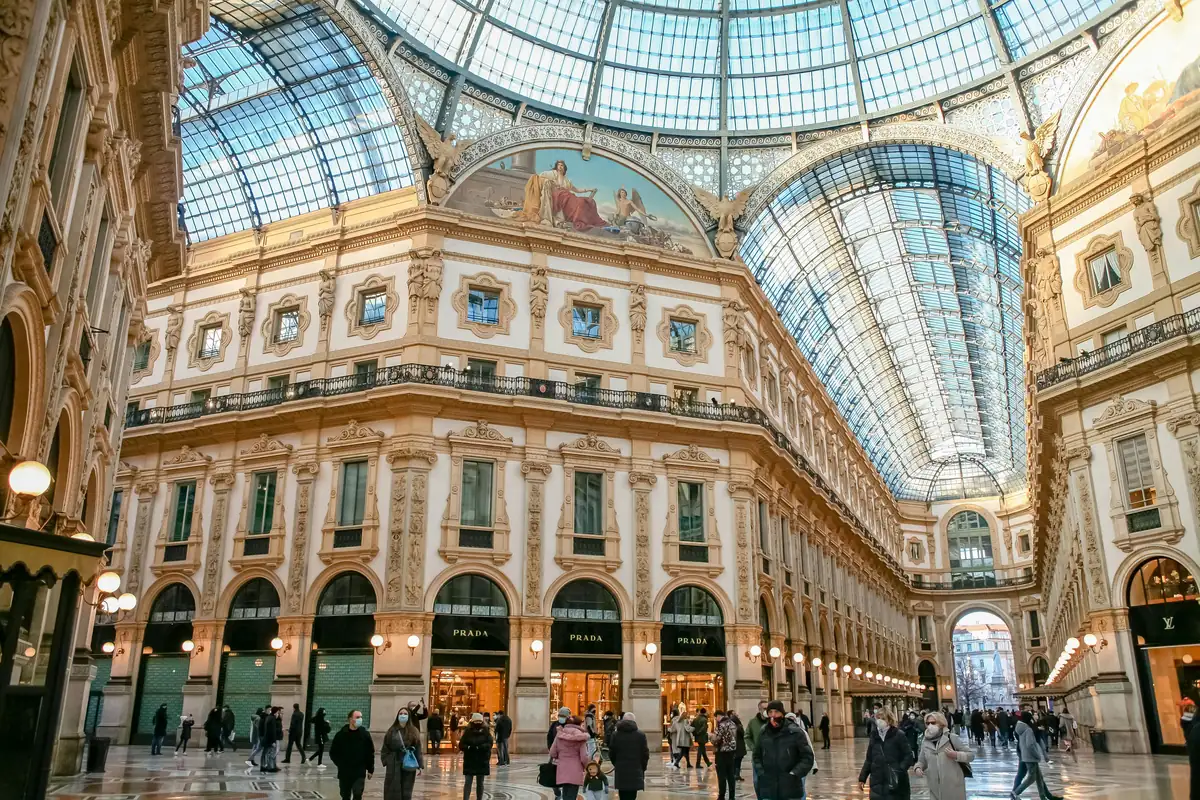
The Block Arcade, running between Collins and Elizabeth Streets, was completed in 1892 and modelled on Milan’s Galleria Vittorio Emanuele II. Look down at the mosaic floor and up at the glass canopy and carved stonework. The Hopetoun Tea Rooms have been serving here since the arcade opened, and the queue for the cake window is part of the scenery; you don’t need to join it to enjoy the arcade.
The Royal Arcade, linking Bourke Street Mall and Little Collins, opened in 1869 and is the oldest surviving arcade in Australia. Its giant painted figures of Gog and Magog flank Gaunt’s clock and strike the hours, which is a small, delightfully odd thing to be standing beneath when it happens. Both arcades are best before 11:00 on a weekday. For the shops inside, see our guide to Melbourne’s best laneways.
Melbourne Town Hall and the Manchester Unity Building
At the corner of Swanston and Collins Streets, the 1870 Melbourne Town Hall faces the 1932 Manchester Unity Building, one of the finest Art Deco towers in Australia. The Town Hall hosts the Melbourne International Comedy Festival every autumn, and its grand organ is played at occasional free concerts. The Manchester Unity’s lobby and its ornate original lifts are worth a look when the building is open. Neither needs more than a few minutes, but together they make the best single street corner for architecture in the city.
State Library Victoria
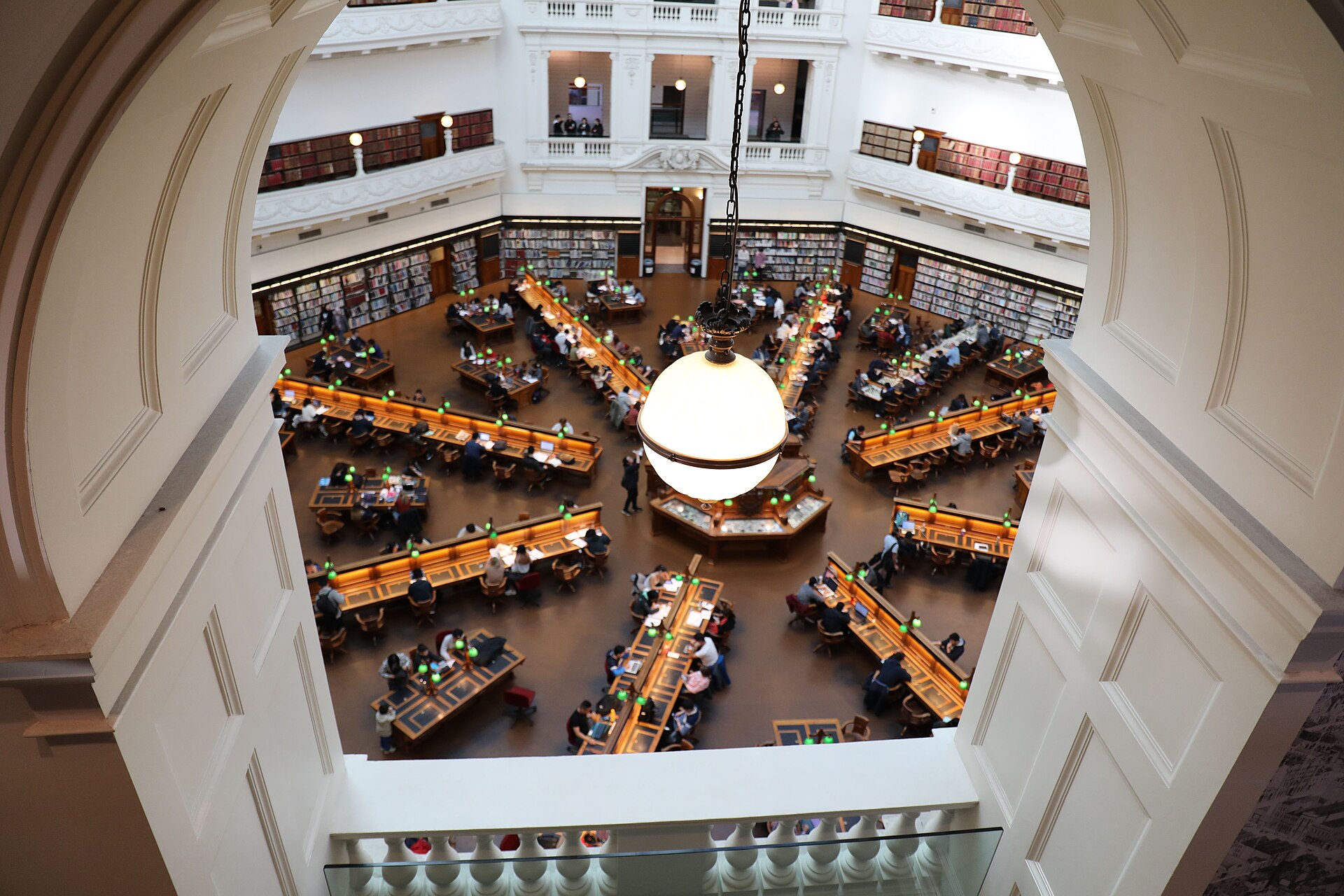
If you only go inside one building in Melbourne, make it this one. State Library Victoria on Swanston Street opened in 1856, making it one of the oldest public libraries in the world, and its octagonal La Trobe Reading Room opened under a vast domed ceiling in 1913. Walk up to the upper balconies and look down: desks radiate out from the centre like spokes, green lamps glow, and hundreds of people read, study and nap in near-silence.
Entry is free and the library is open 10:00–18:00 daily. The dome galleries also hold permanent exhibitions, including the original armour of Ned Kelly and a rotating display of rare books. Balcony levels occasionally close for events, so if the view is your priority, go on a weekday morning. The lawn out front, with its chess players and protest groups, is a Melbourne institution in its own right.
Old Melbourne Gaol
Five minutes up Russell Street, the bluestone Old Melbourne Gaol is where the bushranger Ned Kelly was hanged in November 1880, one of more than 130 executions carried out here. The National Trust runs the site, and admission includes the cells of the old gaol, death masks of executed prisoners, and the neighbouring City Watch House, where actors run you through a mock arrest. It’s open daily 10:00–17:00 and costs A$38 for adults, A$22 for children aged 5–15, and A$90 for a family of two adults and two children. Night tours run on selected evenings.
Is it worth it? For anyone curious about Australia’s colonial history or travelling with teenagers, yes — the Watch House experience is genuinely engaging. For a short trip on a budget, the State Library’s free Kelly displays cover the story well enough.
Coop’s Shot Tower and Chinatown
Inside Melbourne Central shopping centre, a 50-metre red-brick tower built in 1888 to make lead shot stands under a huge glass cone. Coop’s Shot Tower is one of the city’s more surreal sights and completely free; look up from the ground floor and time a visit with the marionette clock’s hourly show.
A block south, the Chinatown gates on Little Bourke Street mark the oldest continuous Chinese settlement in the Western world, established during the gold rush of the 1850s. The landmark here is really the street itself: lanterns, dumpling houses and some of the city’s oldest restaurants.
Parliament House, the Princess Theatre and St Patrick’s Cathedral
At the top of Bourke Street, Parliament House on Spring Street is a magnificent colonnaded building begun in 1856. It housed the Federal Parliament from 1901 until Canberra was ready in 1927. Free guided tours run on days when parliament isn’t sitting; check the parliament’s website for times. Across the road the 1886 Princess Theatre still stages big musicals — and, if you believe the stories, a resident ghost.
Behind Parliament, St Patrick’s Cathedral is the Catholic counterpart to St Paul’s and, to our eyes, the more impressive building. Designed by William Wardell in Gothic Revival style and built from dark bluestone, it took from 1858 until 1939 to complete, and its stained glass is superb in the morning light. Entry is free.
Queen Victoria Market
Trading since 1878, the Queen Victoria Market at the corner of Elizabeth and Victoria Streets is a landmark you can eat your way through. The sheds, deli hall and meat hall trade Tuesday, Thursday, Friday, Saturday and Sunday, and the Wednesday night market runs in summer and winter seasons. Trams 19, 57, 58 and 59 stop close by.
Southbank and the Arts Precinct
Eureka Tower and Melbourne Skydeck
Completed in 2006, the 297-metre Eureka Tower is named after the 1854 Eureka Stockade rebellion on the Ballarat goldfields. The gold-plated glass at its crown represents the gold rush, and the red stripe down its side represents the blood spilled in the uprising. Melbourne Skydeck, on level 88 at 285 metres, is the only public observation deck in the city, reached by a lift that takes about 38 seconds.
Skydeck opens Monday to Thursday 12:00–22:00 and Friday to Sunday 12:00–21:00. The optional extra is The Edge, a glass cube that slides out from the building with you inside. Allow 60 to 90 minutes, and check the current ticket prices online before you go. Our honest verdict: it’s worth it on a clear evening, timed so you see the city in daylight, at sunset and after dark. On a low-cloud day you’ll pay to look at fog. If you’d rather keep your money, the balcony of the Shrine of Remembrance gives a very good free view of the skyline.
The Arts Centre Spire and the NGV
The lattice spire of Arts Centre Melbourne, about 160 metres tall, is the city’s most recognisable silhouette after dark, when it glows in shifting colours. Below it sit the State Theatre, Playhouse and Hamer Hall; our Arts Centre guide covers performances and tours.
Next door, NGV International is Australia’s oldest and most visited art museum. The landmark moments are free: running your hand down the famous waterwall at the St Kilda Road entrance, and lying on your back on the floor of the Great Hall to look up at Leonard French’s enormous stained-glass ceiling. The permanent collection is free too. See our NGV guide for exhibitions.
Polly Woodside and South Wharf
A short walk west along the river, the iron-hulled barque Polly Woodside, built in Belfast in 1885, sits in a dry dock at South Wharf. It’s run by the National Trust and is a good family stop when it’s open, though it’s a secondary landmark next to the others on this list. For more on the area, see our Southbank neighbourhood guide.
Kings Domain and St Kilda Road
Shrine of Remembrance
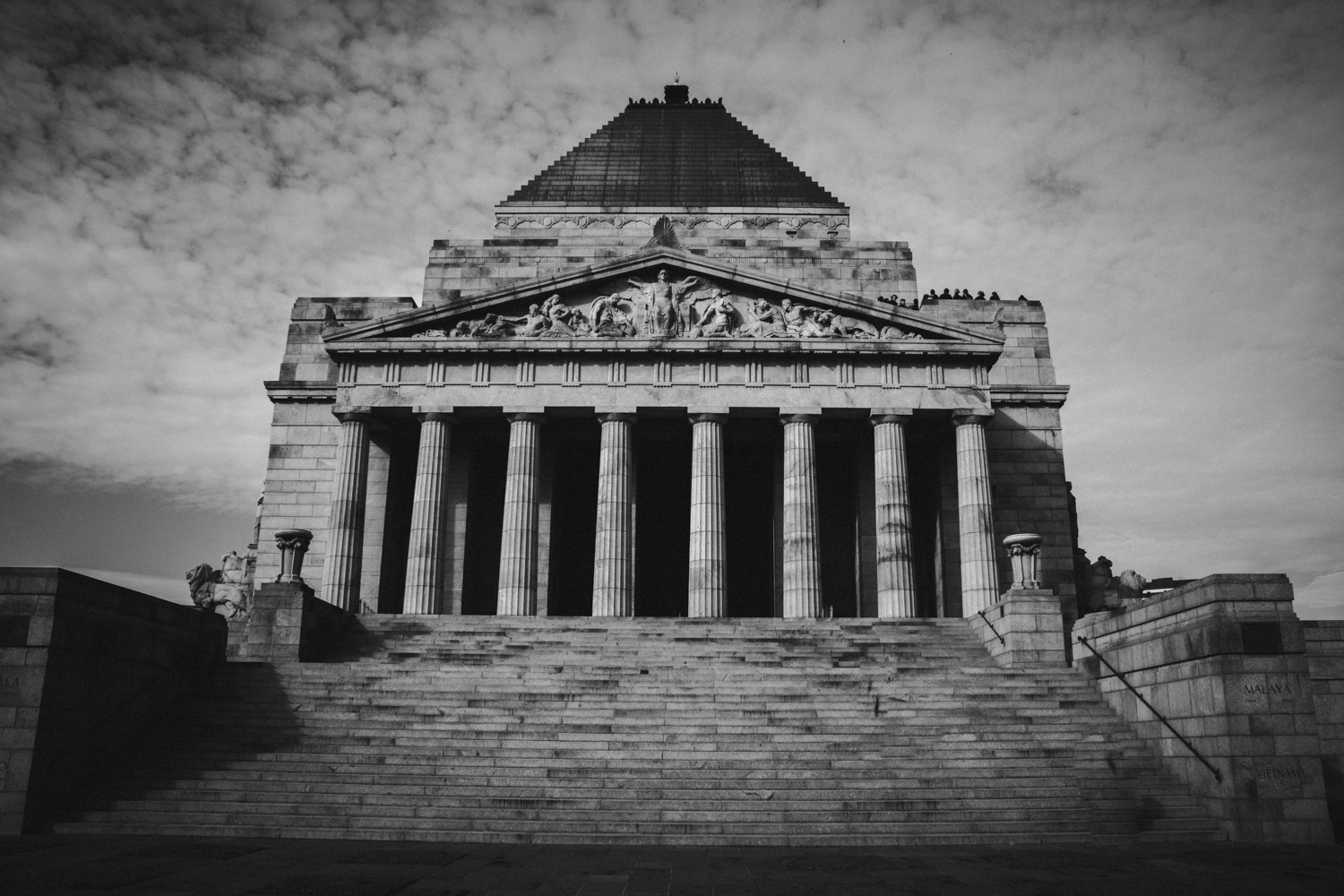
Built to honour Victorians who served in the First World War and opened in 1934, the Shrine of Remembrance is Melbourne’s most solemn landmark and one of its most rewarding. The design borrows from the Mausoleum at Halicarnassus and the Parthenon, and it’s deliberately aligned with Swanston Street so you can see it along the full length of the city’s main avenue.
Inside the Sanctuary, a small opening in the roof lets a beam of sunlight fall on the word “Love” in the Stone of Remembrance at 11:00 on 11 November each year, marking the moment of the 1918 Armistice. Staff recreate the Ray of Light with a mirror system at regular intervals, and it’s quietly moving even for casual visitors. Below, the galleries tell the stories of Victorians in every conflict since, and the balcony gives one of the best free views in Melbourne, straight down St Kilda Road to the towers of the CBD. In the forecourt, the Eternal Flame burns for the dead of the Second World War.
The Shrine is open daily 10:00–17:00 (last entry 16:30), closed on Good Friday and Christmas Day. Entry is free, with no booking needed. Allow an hour. If you’re in town on Anzac Day, 25 April, the Dawn Service here draws tens of thousands.
Royal Botanic Gardens and Sidney Myer Music Bowl
Beside the Shrine, the Royal Botanic Gardens were established in 1846 and spread across 38 hectares of lawns, lakes and collections. They’re free, and the path around Ornamental Lake is one of the city’s best short walks. On the northern edge of Kings Domain, the curved roof of the Sidney Myer Music Bowl, opened in 1959, hosts outdoor concerts through the warmer months.
Tucked in the gardens is La Trobe’s Cottage, the prefabricated home shipped from England for Charles La Trobe, Victoria’s first lieutenant-governor, in 1839. Check the National Trust’s website for open days before making a special trip.
Carlton: The Royal Exhibition Building
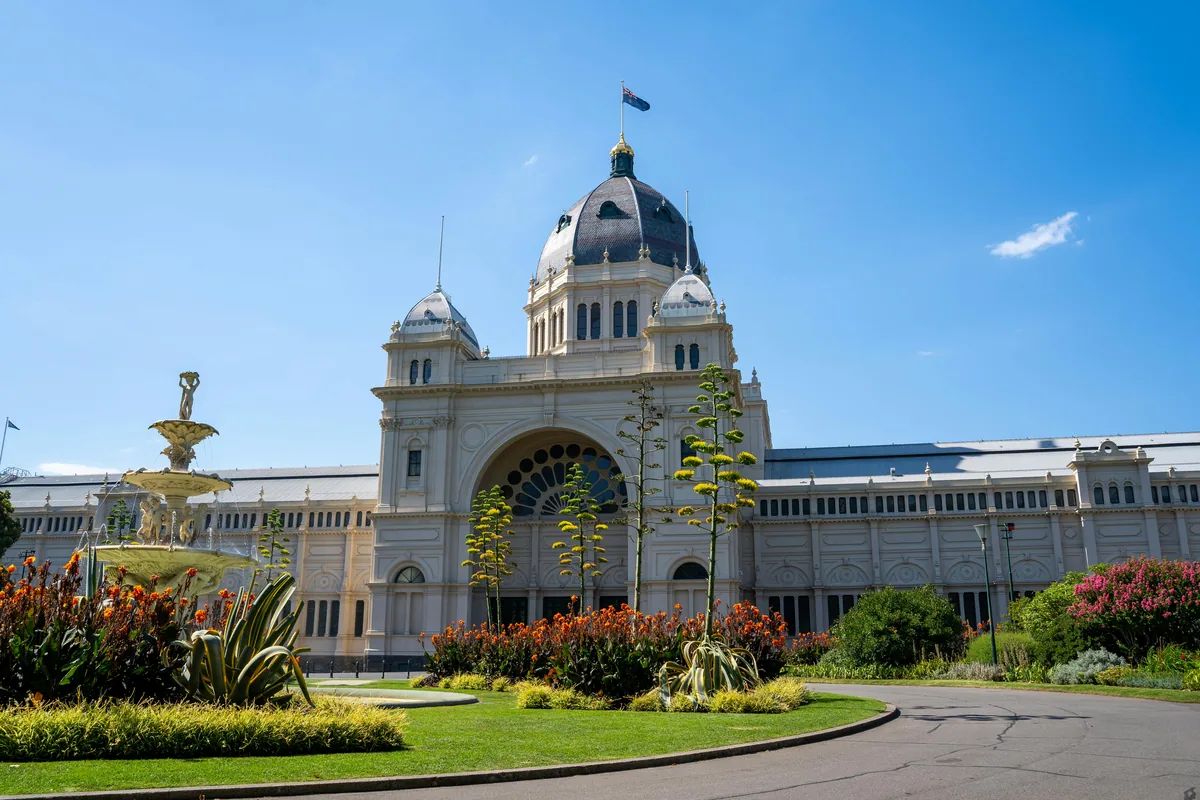
The Royal Exhibition Building, built for the 1880 Melbourne International Exhibition, is the grandest surviving monument to Marvellous Melbourne. In 1901 it hosted the opening of the first Parliament of Australia, and in 2004 it became the first building in the country to be inscribed on the UNESCO World Heritage List, together with the surrounding Carlton Gardens. It is still in use for exhibitions, trade shows and university exams.
From the gardens, you can admire the facade and the dome at no cost. To see more, book the Dome Promenade tour run by Museums Victoria. The 60-minute guided tour takes you through the building’s history and out onto the promenade around the base of the dome, with views across Carlton and the city. It costs A$29 for adults, A$23 for concessions and seniors, A$15 for children and A$65 for a family, and it includes entry to the Melbourne Museum next door — which makes the ticket good value. Tours run at 10:00 and 14:00 on weekdays and four times a day on weekends. The upper promenade is stairs only; the lower promenade is reachable by lift.
Carlton itself, with Lygon Street’s Italian cafés, is a natural place to finish; our Carlton guide has the details.
East Melbourne and Richmond
Melbourne Cricket Ground
Melburnians call it “the G”, and the Melbourne Cricket Ground is as close to a cathedral as a secular city gets. Established in 1853, it holds around 100,000 people and has hosted the 1956 Olympic Games, the AFL Grand Final, the Boxing Day Test and a century and a half of sporting drama. Even on a non-match day it’s worth seeing.
Guided MCG tours start inside Gate 3, last about 75 minutes, and cost from around A$27; a combined ticket with the Australian Sports Museum is around A$36. Tours visit the MCC Long Room, the MCC Library founded in 1873, the player change rooms, and — the part everyone remembers — a walk onto the edge of the arena. It’s a 15-minute walk from Flinders Street through Yarra Park, or take the train to Richmond or Jolimont.
Next door, Melbourne Park, home of the Australian Open, and the geodesic “bubble” roof of AAMI Park complete the sports precinct.
Fitzroy Gardens and Cooks’ Cottage
The Victorian-era Fitzroy Gardens in East Melbourne are laid out in the pattern of the Union Jack and hold one of Melbourne’s more unusual landmarks: Cooks’ Cottage, the home of Captain James Cook’s parents, which was dismantled in Great Ayton, Yorkshire, shipped to Melbourne and rebuilt here in 1934. The cottage has paid entry. Worth knowing before you go: for many Aboriginal Australians, Cook’s arrival marks the start of dispossession rather than a founding story, and the cottage has been a focus of protest around 26 January. The gardens also have a conservatory, the Fairy Tree carved by Ola Cohn in the 1930s, and a scarred river red gum from which Aboriginal people once removed bark.
Bayside Landmarks
Luna Park and St Kilda Pier
You enter Luna Park through the gaping mouth of Mr Moon, a giant grinning face that has greeted visitors since 1912. The Scenic Railway, which opened the same year, is the oldest continuously operating roller coaster in the world, and the park still has the unashamed kitsch of an old seaside fairground. You can look at the entrance for free; rides are ticketed.
A few minutes’ walk away, St Kilda Pier stretches into Port Phillip Bay, with a colony of little penguins living among the rocks of the breakwater. Sunset on the pier, with the city skyline to the north, is one of the loveliest free experiences in Melbourne. Combine it with dinner on Acland Street and a walk along the Esplanade; our St Kilda guide covers the neighbourhood. Take tram 96 from Bourke Street or tram 16 from Swanston Street.
Brighton Bathing Boxes
On Dendy Street Beach in Brighton, 93 brightly painted wooden bathing boxes line the sand, each individually owned and decorated. It’s free to see, and the boxes are private property, so admire them without climbing on them. Take the Sandringham line train to Middle Brighton and walk about 15 minutes, or catch bus 216 or 219. Late afternoon light is best. They’re charming, but an hour is plenty; combine them with a swim or a walk along the bay rather than making them the whole outing. Our guide to Melbourne’s best beaches can help you plan the rest of the day.
Aboriginal Landmarks in Melbourne
Melbourne is built on the lands of the Wurundjeri Woi-wurrung and Bunurong peoples of the Kulin Nation, and some of the city’s most significant places don’t look like conventional landmarks at all.
- Birrarung (the Yarra) — the river itself is the city’s oldest landmark and was central to life, trade and ceremony long before settlement.
- Koorie Heritage Trust, Federation Square — exhibitions, a shop of Aboriginal art and design, and guided walks along the Birrarung.
- Bunjilaka Aboriginal Cultural Centre, Melbourne Museum — the museum’s First Peoples exhibition is one of the most important in the country.
- The Corroboree Tree, St Kilda — a river red gum estimated at several hundred years old on Queens Road near St Kilda Junction, believed to have been a meeting place for the Bunurong and other Kulin peoples.
- Scarred trees — including the one in Fitzroy Gardens, where bark was cut to make canoes, shields or containers.
To go deeper, our guide to Indigenous culture experiences in Melbourne lists guided tours and cultural centres.
A One-Day Landmarks Walk
This route links the most important landmarks in a single day, mostly on foot, with a couple of tram rides. It’s around 10 km of walking in total, so wear comfortable shoes.
- 09:30 — Flinders Street Station and St Paul’s Cathedral. Start under the clocks, then cross to the cathedral.
- 10:00 — Federation Square and Hosier Lane. A quick look at the plaza and ACMI, then the laneway before the crowds.
- 10:45 — Block Arcade and Royal Arcade. Wander through, and try to be under Gog and Magog on the hour.
- 11:30 — State Library Victoria. Climb to the dome balconies.
- 12:30 — Lunch in Chinatown or at the Queen Victoria Market.
- 14:00 — Royal Exhibition Building Dome Promenade. Take the tram along Nicholson Street or walk 15 minutes from the library.
- 15:30 — Parliament House and St Patrick’s Cathedral. Walk down through the gardens to Spring Street.
- 16:30 — The Shrine of Remembrance. Take a tram down St Kilda Road; arrive before the 16:30 last entry and finish on the balcony.
- 18:30 — Southbank at dusk, with Skydeck if the sky is clear, or dinner by the river if it isn’t.
For a longer stay, our three-day Melbourne itinerary spreads these landmarks out and adds the MCG, St Kilda and the bayside.
Melbourne’s Landmarks After Dark
A lot of Melbourne’s landmarks are better at night, and seeing them lit up costs nothing. The city is at its most photogenic in the hour after sunset, when the sky over the bay is still deep blue and the buildings have switched on.
- Flinders Street Station is floodlit gold, and the view from the Southbank side of Princes Bridge, with the station reflected in the Yarra, is the classic night shot of the city.
- The Arts Centre spire cycles through coloured light. Watch it from the lawns of Queen Victoria Gardens or from Birrarung Marr across the river.
- Southbank Promenade comes alive with restaurants and bars, and the gas brigades outside Crown shoot fireballs into the air on the hour after dark through much of the year — one of the city’s odder free shows.
- Federation Square hosts outdoor screenings, festivals and big-match crowds, and is the gathering point for New Year’s Eve.
- The Shrine of Remembrance is lit after dark, and although the building is closed, the grounds and the view back up St Kilda Road to the lit-up city are beautiful.
- Skydeck stays open until 21:00 or 22:00, so you can watch the lights come on from 285 metres up.
For more ideas, including night markets and late-opening galleries, see our guide to things to do in Melbourne at night.
Landmarks for a Rainy Day
Melbourne’s famously changeable weather doesn’t have to derail a sightseeing day. Many of the best landmarks are indoors, and several connect by covered arcades and short tram rides. On a wet day, work your way through the State Library, the Block and Royal Arcades, Coop’s Shot Tower inside Melbourne Central, St Paul’s and St Patrick’s Cathedrals, NGV International and ACMI. Add the Old Melbourne Gaol, whose cells and Watch House are mostly under cover, and the Melbourne Museum, which is included with the Royal Exhibition Building dome tour. Skip anything that relies on a view, like Skydeck or the Shrine balcony, and save St Kilda Pier for a clear evening. Our rainy day in Melbourne guide has a full wet-weather plan.
Modern Landmarks and Docklands
Not every Melbourne landmark is Victorian. The city’s newer icons are mostly architectural, and several are worth a detour if you like design. Docklands, on the western edge of the CBD, has the curving white Webb Bridge, a pedestrian and cycle bridge whose woven steel form was inspired by Aboriginal eel traps, and views of the Bolte Bridge and its twin grey towers. Marvel Stadium, with its retractable roof, is Melbourne’s second big football ground. In the CBD, the green-and-purple tiled facade of RMIT’s Storey Hall on Swanston Street and the tall glass Melbourne Central cone are good examples of how the city layers new buildings over old. None of these needs more than a quick look, but they help you understand how Melbourne sees itself — as a design city, not just a heritage one. Our Docklands guide covers the waterfront in more detail.
Free Landmarks vs Paid Landmarks
Melbourne is unusually generous with its landmarks. You can see most of them without spending a cent.
| Free | Paid |
|---|---|
| Flinders Street Station, Federation Square, Hosier Lane | Melbourne Skydeck and The Edge |
| State Library Victoria and its dome | Old Melbourne Gaol (A$38 adult) |
| Shrine of Remembrance and its balcony | Royal Exhibition Building Dome Promenade (A$29 adult, includes Melbourne Museum) |
| St Paul’s and St Patrick’s Cathedrals | MCG tour (from ~A$27) |
| Block Arcade, Royal Arcade, Coop’s Shot Tower | Cooks’ Cottage |
| NGV International permanent collection, ACMI, Koorie Heritage Trust | Luna Park rides |
| Parliament House tours (non-sitting days) | Polly Woodside |
| Royal Botanic Gardens, Fitzroy Gardens, Carlton Gardens | Special exhibitions at the NGV and Melbourne Museum |
| St Kilda Pier, Brighton Bathing Boxes |
If you plan to pay for several attractions, check whether a bundle ticket makes sense for your plans. Our comparison of Melbourne city cards and passes works through the numbers, and the answer is often that they don’t pay back. For a longer list of zero-cost options, see our free things to do in Melbourne.
What’s Overrated, and What’s Underrated
Overrated (or best handled differently)
- Skydeck on a grey day. The view is the whole product. Check the forecast and the cloud base before you buy.
- Federation Square as a destination. Go for ACMI, the Ian Potter Centre and the Koorie Heritage Trust; the plaza on its own is a place to pass through.
- Hosier Lane at midday. It’s crowded and the art changes so fast that it may not look like the photos. Go early or visit less famous lanes.
- Brighton Bathing Boxes as a half-day trip. They’re lovely for 45 minutes, not for three hours.
Underrated
- The Shrine’s balcony. A free city view that rivals the paid ones.
- St Patrick’s Cathedral. Most visitors see only St Paul’s; St Patrick’s is the more dramatic interior.
- The Royal Exhibition Building dome tour. Few tourists book it, and it’s excellent value with museum entry included.
- The Manchester Unity Building. An Art Deco gem most people walk straight past.
- Coop’s Shot Tower. A 19th-century tower inside a shopping centre is the kind of thing only Melbourne would do.
Practical Tips for Seeing Melbourne’s Landmarks
- Use the free trams. The City Circle tram (route 35) runs heritage trams around the edge of the CBD past many landmarks, free of charge.
- Carry a Myki for everything beyond the free zone. The Shrine, MCG, Royal Exhibition Building and St Kilda are just outside it. Our Myki card guide explains how to top up and touch on.
- Go early. The State Library, arcades and Hosier Lane are far better before 11:00.
- Check closures. The Shrine and Old Melbourne Gaol close on Good Friday and Christmas Day, and Parliament House tours depend on sitting days.
- Photograph at the right time. Flinders Street Station and the Arts Centre spire look best after dark; the Shrine and Royal Exhibition Building in morning light; St Kilda Pier at sunset. Our most Instagrammable places in Melbourne has more angles.
- Dress for four seasons. The walk from the CBD to the Shrine is exposed, and Melbourne weather changes fast.
Melbourne Landmarks FAQ
What is Melbourne’s most famous landmark?
Flinders Street Station is the most recognisable, closely followed by the MCG, Federation Square and the Royal Exhibition Building. For international visitors, the Twelve Apostles on the Great Ocean Road are the most famous sight in Victoria, though they’re a few hours’ drive from the city.
What landmarks in Melbourne are free?
Most of them: Flinders Street Station, Federation Square, State Library Victoria, the Shrine of Remembrance, both cathedrals, the arcades, NGV International’s permanent collection, the Royal Botanic Gardens, St Kilda Pier and the Brighton Bathing Boxes.
Is Melbourne Skydeck worth it?
On a clear day, especially at sunset, yes. It’s the only observation deck in the city. On a cloudy or rainy day, skip it and use the Shrine of Remembrance balcony for a free view instead.
Which Melbourne landmark is on the UNESCO World Heritage List?
The Royal Exhibition Building and Carlton Gardens, listed in 2004. It was the first building in Australia to receive World Heritage status.
How long do you need to see Melbourne’s main landmarks?
The CBD, Southbank and Kings Domain landmarks can be covered in one full day on foot. Add half a day for the MCG and the Royal Exhibition Building tour, and another half day for St Kilda and Brighton.
Can you go inside Flinders Street Station?
Yes — it’s a working railway station and the concourse is open whenever trains are running. The historic upper floors, including the old ballroom, are not open to the public.
What’s the best free view of Melbourne?
The balcony of the Shrine of Remembrance, looking north along St Kilda Road to the city. The upper balconies of the State Library’s dome give the best free interior view.
Related Melbourne Guides
- Things to Do in Melbourne
- Free Things to Do in Melbourne
- Melbourne CBD Guide
- NGV Melbourne Guide
- Melbourne Museum: The Complete Guide
- Royal Botanic Gardens Melbourne
- Luna Park Melbourne
- Melbourne Arts and Culture
Photo Credits
Eureka Tower, Arts Centre spire and Princes Bridge from the north bank of the Yarra: Eureka Tower and Yarra River – Melbourne by Donaldytong, CC BY-SA 3.0, via Wikimedia Commons.
La Trobe Reading Room, State Library Victoria: La Trobe Reading Room viewed through archway State Library Victoria by Bhullargraphic, CC BY-SA 4.0, via Wikimedia Commons.
Shrine of Remembrance: At the shrine of remembrance by Damien Tait, CC BY-SA 4.0, via Wikimedia Commons.